
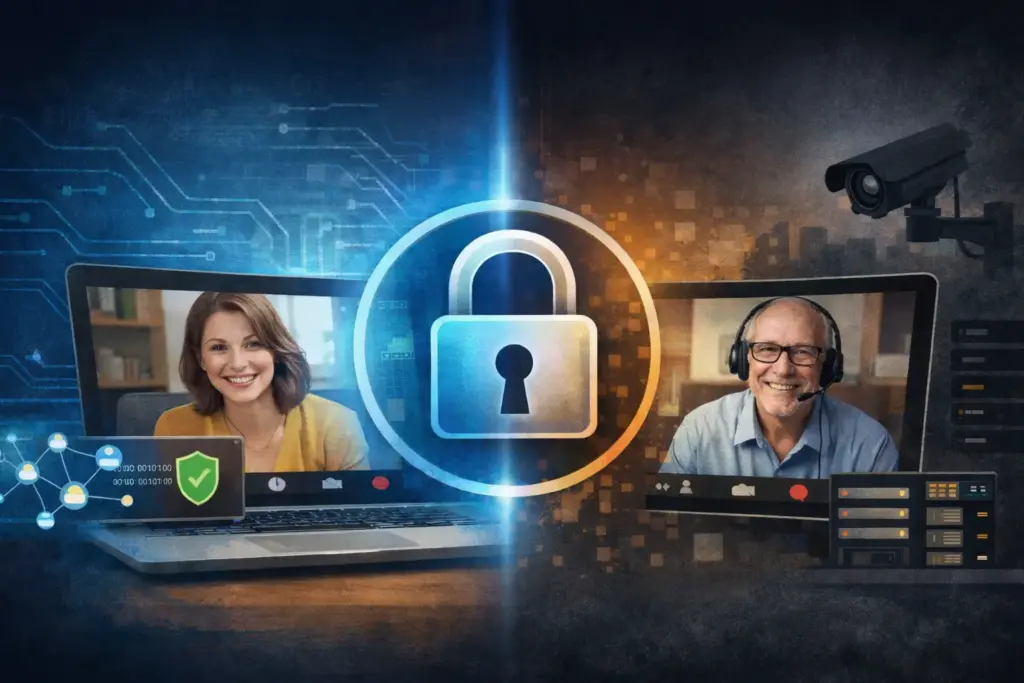
Can a Video Call Ever Be Totally Private?
It’s a simple question.
But it’s not a simple answer.
Most people assume that if a video app says “end-to-end encrypted”, that means private. Done. Safe. No worries.
But privacy isn’t just encryption. It’s about who controls the infrastructure.
And that’s where things get interesting.
Why People Are Asking This Now?
When someone searches this, they’re usually worried about one of five things?
- Can someone listen in?
- Is this being recorded
- Does the company scan the call?
- What happens to the data afterwards?
- What if their servers get hacked?
That concern isn’t paranoia.
Platforms like Zoom faced major scrutiny during their rapid growth. Meanwhile, companies like Meta — which owns WhatsApp — operate under business models built around data ecosystems.
Even if calls are encrypted, the surrounding system still exists.
And that’s the part most people never think about.
So, what Does “End-to-End Encrypted” Actually Mean?
You’ve seen the phrase everywhere.
“End-to-end encrypted.” – Usually with a little lock icon.
It sounds like privacy magic. But it’s actually something very specific.
The Simple Version
End-to-end encryption means:
Only the people on the call can read or hear the conversation.
The video and audio are scrambled on your device, travel across the internet as gibberish, and are only unscrambled on the other person’s device.
Even the company running the service shouldn’t be able to listen in.
That’s the theory.
Platforms like WhatsApp and Zoom offer versions of this on certain calls. So far, so good.
But here’s where people get misled.
What End-to-End Encryption Does Not Do
End-to-end encryption protects the content of the call.
It does not automatically protect:
- Who you called
- When you called
- How long you talked
- Your IP address
- Your device details
- Your account information
That’s metadata.
And metadata paints patterns.
If your elderly parent calls you every evening at 7pm for 40 minutes, that pattern exists whether anyone hears the conversation or not.
So when people ask about “total privacy”, what they’re really asking is:
“Is there a third party in the middle?”
That’s the real question.
And it can reveal patterns about your life without anyone hearing a word. Encryption also doesn’t change who owns the server.
If a company controls the infrastructure, they control:
- Updates
- Features
- Retention rules
- Account access
- Terms of service
So “end-to-end encrypted” is one important layer — but not the whole privacy story.
Why the Details Matter
Some services only enable end-to-end encryption in certain modes.
Some require special settings.
Some use server-side recording features.
Some fall back to weaker encryption for group calls.
And most people never check.
So the real question isn’t just:
“Is it encrypted?”
It’s:
“Who controls the system around the encryption?”
That’s where architecture matters.
Where Self-Hosted Systems Fit In
When you run your own communication server, you still use encryption — but you also remove the commercial middleman and take full control of the meta data bit too.
With a tiny box wired up to your router like Liberation Technical Solutions Private-Cloud family of tools:
Family-Cloud-Connect – For private family communications and simplifying video check-ins with elderly parents. Small, discrete connection.
Porthol – Private client portals that allow you to talk and work and share with your clients in private in a space that assures them that their files/data are not visible to any third parties. One place to find all they need from you. When they need it.
Your video calls and messaging run on a secure box you control, that allows you to use any of your devices to talk, chat and share securely and privately with your family or clients anywhere.
So you get:
- Encrypted calls
- Controlled infrastructure
- No advertising model
- No behavioural tracking
Encryption + meta data ownership.
That’s what real-world privacy looks like.
So… Can It Ever Be Totally Private?
On the public internet, absolute invisibility doesn’t exist. There are always network routes. There is always infrastructure.
But practical privacy? Yes.
If you remove the commercial middleman.
If you control the server.
It’s an architecture decision. And once you understand that, the question changes from:
“Is this encrypted?”
To:
“Where is my data sitting?”
That’s a choice most people have never been offered.
So, if you’re after more privacy for family or your business in Hertfordshire you’re in luck. Liberation Technical Solutions install and support locally. Real privacy supplied by real humans, offering real help and support.
If you want to see how your family or business fit with extra privacy you can contact them here to book a chat.
Privacy isn’t hiding. It’s peace and calm with a large helping of regaining control.
Till next time
Tim